
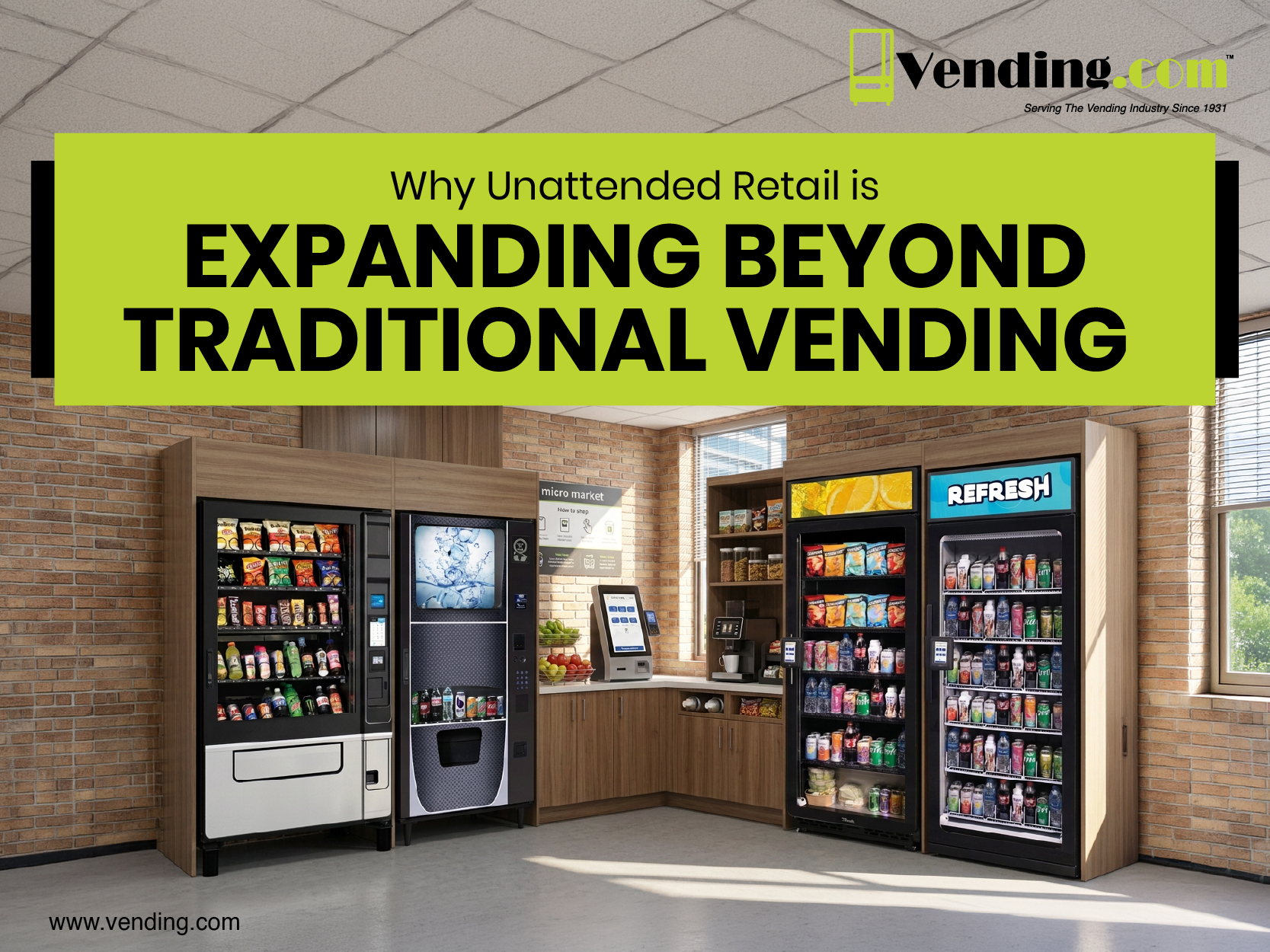
“Can we offer customers more without opening a full retail store?”
That question is changing the way businesses think about vending.
Traditional vending remains a practical way to provide snacks, beverages, and everyday essentials. But customers increasingly expect more choice, fresher products, and convenient, around-the-clock access. At the same time, businesses are looking for ways to add retail access without the labor, space, and overhead associated with a traditional staffed location.
That is where unattended retail expansion comes in.
For operators, this does not necessarily mean moving away from vending. It means having more formats to choose from. Vending.com, for example, offers traditional vending machines alongside AI smart coolers, self-checkout kiosks, and retail lockers.
Unattended retail is expanding beyond traditional vending because businesses want broader product assortments, convenient 24/7 access, flexible retail formats, and technology that supports automated shopping without the overhead of a staffed store.
What Is Unattended Retail?
Unattended retail is a self-service retail model that allows customers to browse, select, and purchase products without interacting with a cashier or sales associate. Common unattended retail formats include vending machines, smart coolers, micro markets, smart stores, automated kiosks, and self-checkout retail environments.
Why Is Unattended Retail Growing Beyond Traditional Vending?
Several forces are driving automated retail growth.
Consumers want convenient access to products when and where they need them, including outside traditional retail hours. Businesses, meanwhile, face labor constraints and rising operating costs while looking for ways to use smaller or underused spaces more effectively.
Technology is also reducing some of the limitations of traditional vending.
Cashless payments, remote monitoring, connected equipment, computer vision, and automated checkout can make unattended retail more flexible and easier to manage.
These innovations not only improve customer experience but also reduce operator costs by streamlining replenishment and maintenance.
The numbers reflect the broader shift. The U.S. convenience services industry generated an estimated $40.04 billion in revenue in 2025, according to the 2026 State of the Vending & Micro Market Industry report. More than 70% of surveyed operators increased the number of locations they served, while smart coolers became a mainstream equipment category.
This does not mean traditional vending is disappearing. It means operators have more retail automation channels to choose from.
What Types of Unattended Retail Exist Today?
Unattended retail is a retail environment where customers can browse, select, and purchase products without interacting with a cashier or sales associate.
Vending machines are one type of unattended retail. Other formats include:
- Traditional vending machines
- Smart coolers
- Micro markets
- Smart stores
- Automated retail kiosks
- Specialized vending machines
NAMA describes micro markets as unattended retail environments where customers select products from shelves or open coolers and complete purchases through self-checkout.
The simplest way to understand the relationship is:
Unattended retail = the broader retail model.
Vending = one format within that model.
That distinction matters as businesses look beyond traditional vending for ways to offer more products and different shopping experiences.
Vending.com’s product portfolio illustrates this broader definition. Alongside traditional snack, beverage, combination, and food vending machines, we also offer AI smart coolers, self-checkout kiosks, and retail lockers.
Unattended Retail vs Traditional Retail
Many businesses evaluating unattended retail are not deciding between vending formats alone. They often compare unattended retail with a traditional staffed retail model. While both approaches can provide product access and customer convenience, they differ significantly in staffing requirements, operating costs, footprint, and scalability.
The table below highlights key differences.
| Feature | Unattended Retail | Traditional Retail |
| Staffing | Minimal or no on-site staff required during customer transactions | Requires employees during operating hours |
| Operating Hours | Can provide 24/7 access | Usually limited to staffed business hours |
| Footprint | Can operate in compact spaces | Typically requires dedicated retail space |
| Setup Requirements | Equipment-based deployment | Full store buildout and staffing model |
| Product Access | Self-service purchasing | Associate-assisted or cashier-supported purchasing |
| Scalability | Easier to replicate across multiple locations | Expansion typically requires additional staff and store resources |
| Operating Costs | Reduced labor requirements compared to staffed retail | Higher labor and operational overhead |
| Customer Experience | Fast, convenient, self-service transactions | Personalized human interaction and assistance |
| Best For | Offices, hospitals, campuses, hotels, gyms, airports, residential communities, and other convenience-focused locations | Larger retail environments requiring extensive product selection and customer support |
While traditional retail remains the right fit for many applications, unattended retail offers businesses another way to provide product access, extend service hours, and reach customers in locations where a full retail footprint may not be practical.
What Is Driving the Shift Away from Traditional Vending?
Consumers Want More Choice
A traditional vending machine works well when customers need a small selection of products quickly.
But some locations need more. Fresh meals, healthier snacks, premium beverages, personal care products, electronics accessories, and other specialty products may require a different retail format.
This is one reason businesses are exploring new vending machine categories, smart coolers, and micro markets.
Customers Want a More Natural Shopping Experience
Traditional vending follows a simple process:
Select → Pay → Dispense
Newer unattended retail formats can provide:
Browse → Choose → Purchase → Go
That difference matters when customers need to compare products, buy multiple items, or shop from a larger assortment.
Customers Expect Retail-Like Experiences
Many customers now expect broader product selection, refrigerated meals, healthier options, and frictionless checkout experiences that traditional vending may not always provide.
Businesses Want Convenient Access Without Full Retail Staffing
A staffed store requires employees to be present during operating hours.
Unattended retail can extend access without creating the same staffing model.
That makes it relevant for offices, manufacturing facilities, hospitals, universities, airports, hotels, gyms, and multifamily property locations where customers may need products outside conventional retail hours.
Underused Spaces Can Become Retail Opportunities
A full store is not practical for every location.
A lobby, break room, hallway, employee area, or residential common space may have enough traffic to support a smaller automated retail location.
The right format can turn previously underutilized space into a convenient retail access point.
What Are the Main Types of Unattended Retail?
Traditional Vending Machines
Traditional vending remains effective when a location needs:
- A compact footprint
- A straightforward assortment
- Fast individual purchases
- Familiar customer behavior
- Reliable 24/7 access
For many locations, there is no reason to replace a model that already works.
Smart Coolers
Smart coolers combine refrigerated product access with technology that can support a more retail-like experience.
They can be useful for fresh food, beverages, and other products that benefit from open product visibility.
Their role is growing. In the 2026 industry survey, smart coolers represented 33.5% of equipment deployed by respondents, nearly matching traditional glass-front vending machines.
Vending.com’s AI Smart Cooler portfolio includes solutions designed for snacks, beverages, fresh food, and other grab-and-go products, with options ranging from compact units to larger-capacity systems.
Micro Markets
Micro markets provide a larger shopping environment with open shelving, coolers, and self-checkout.
They can accommodate a broader assortment than a traditional vending machine, making them useful when customers need more choice.
However, they also require more space and operational planning.
Smart Stores and Other Automated Formats
Smart stores and other emerging formats take unattended retail further by combining connected equipment, automated checkout, and retail-style merchandising.
These formats can make higher-value products and broader assortments practical in locations where a traditional vending machine may not be enough.
How Is Technology Changing Unattended Retail?
Technology is expanding what automated dispensing beyond snacks can look like.
- Cashless and contactless payments speed up checkout and reduce dependence on cash.
- Computer vision and product recognition can identify products as customers remove them from smart retail equipment.
- Automated checkout can reduce friction by allowing customers to complete purchases without a conventional cashier.
- Remote monitoring gives operators greater visibility into equipment, transactions, and potential issues.
- Inventory visibility helps operators understand what is selling and when products need replenishing.
Together, these technologies help unattended retail function less like a simple dispenser and more like a connected retail channel.
Why Are Businesses Expanding Beyond Traditional Vending?
For operators, vending machine diversification can create opportunities to meet different customer needs and serve more locations.
- A manufacturing facility might benefit from traditional vending for snacks and beverages.
- A hospital may need fresh food, beverages, or personal-care essentials available around the clock.
- A university campus may need broader food and beverage access across multiple buildings.
- A gym could benefit from beverages, protein products, and fitness-related merchandise.
- A hotel might use unattended retail to give guests convenient access to snacks, drinks, travel necessities, or other products after the front desk’s normal service hours.
The opportunity is not necessarily to choose one format for every location. It is about matching the unattended retail use case to the location.
Which Unattended Retail Format Is Right for a Location?
Is Traditional Vending Being Replaced? Not necessarily.
Traditional vending remains valuable because it offers a compact footprint, familiar purchasing behavior, and a relatively straightforward operating model.
In fact, current industry data suggests the market is becoming more diversified rather than simply replacing one format with another. Smart coolers are growing while traditional vending remains an important equipment category.
The table below highlights common location needs and the unattended retail formats best suited to meet them.
| Location Need | Potential Format |
| Simple Snacks and Drinks | Traditional Vending |
| Limited Space | Traditional Vending or AI Smart Cooler |
| Fresh Food | AI Smart cooler |
| Large Product Assortment | Micro Market or AI Smart Cooler |
| High-Traffic | Traditional Vending, Micro Market or Smart Store |
| Premium Products | AI Smart Cooler |
| 24/7 product access | Multiple unattended formats |
| Multiple Needs Across Locations | Combination Approach |
The bigger opportunity is unattended retail expansion using the right combination of formats to serve more locations, products, and customer needs.
Ready to match the right format to your location?
Don’t limit your business to snacks and drinks. Explore smart coolers, micro markets, and automated retail solutions from Vending.com to expand product variety, maximize underused spaces, and deliver 24/7 convenience.
How Should Businesses Evaluate Unattended Retail Options?
Start with five questions:
1. Who is the customer?
Understand who will use the location and what they are likely to purchase.
2. What does the location allow?
Consider traffic, available space, security, operating hours, and accessibility.
3. What products are needed?
Determine whether customers need snacks and beverages or a broader assortment, including fresh food, specialty products, or non-food items.
4. What operational model makes sense?
Consider replenishment, inventory management, monitoring, maintenance, and service requirements.
5. What technology solves an actual problem?
Choose technology based on the customer and business need—not simply because it is newer.
What Does the Future of Unattended Retail Look Like?
The next stage of automated retail growth is likely to be less about a single “best” format and more about flexibility.
Smart coolers, connected vending, micro markets, automated checkout, and other self-service formats can coexist within the same retail strategy.
For operators, that creates new opportunities to enter locations that may not have supported traditional vending or a staffed store.
For businesses, it creates another way to provide 24/7 automated retail access without building a conventional retail footprint.
Key Takeaways
- Unattended retail is broader than traditional vending.
- Consumer expectations are pushing businesses toward greater product variety and convenience.
- Smart coolers and micro markets are expanding the range of unattended retail formats.
- Technology is making self-service retail more connected and flexible.
- Traditional vending remains effective for locations where compact, straightforward service is the priority.
- The best format depends on the location, customer, product mix, and operational requirements.
- Unattended retail expansion is creating new opportunities for vending operators, businesses, and brands.
Ready to Expand Your Unattended Retail Strategy?
The right unattended retail format depends on your location, customer needs, product mix, and operating model.
Explore Vending.com’s unattended retail solutions and find the right fit for your next location and unlock new revenue streams.
FAQs
1. What is unattended retail?
Unattended retail is a retail model where customers can select and purchase products without interacting with a cashier or sales associate. Examples include vending machines, smart coolers, and micro markets.
2. Why is unattended retail growing?
Demand for convenience, 24/7 access, cashless payments, broader product assortments, and less dependence on on-site staffing are driving unattended retail growth.
3. How is unattended retail different from vending?
Vending is one type of unattended retail. Unattended retail also includes micro markets, smart coolers, smart stores, and other automated retail formats.
4. What products can unattended retail offer?
Depending on the format and location, unattended retail can offer snacks, beverages, fresh food, meals, electronics accessories, personal-care products, specialty products, and other merchandise.
5. Are smart coolers considered unattended retail?
Yes. Smart coolers are an unattended retail format that combines refrigerated product access with technologies such as cashless payment, product recognition, and inventory monitoring.
6. Are micro markets considered unattended retail?
Yes. Micro markets are unattended retail environments where customers can browse products on open shelves and coolers and complete purchases through self-checkout.
7. Is unattended retail cheaper than staffed retail?
It can reduce the need for continuous on-site retail staffing, but total costs vary by format, equipment, technology, location, inventory, and operating model. Businesses should compare the full retail footprint, not equipment cost alone.
8. What should a business consider before choosing an unattended retail solution?
Consider customer needs, location traffic, available space, security, product mix, operating hours, replenishment requirements, technology needs, and expected sales before selecting a format.
9. What Products Are Sold in Vending Machines Today?
Modern vending machines can dispense snacks, beverages, fresh food, electronics accessories, personal-care products, PPE, over-the-counter medications, and many other products depending on machine configuration.
10. What Is the Difference Between a Smart Cooler and a Micro Market?
A smart cooler is a refrigerated self-service unit that uses technology such as automated checkout and product recognition. A micro market is a larger unattended retail environment that combines open shelving, refrigeration, and a self-checkout system.
11. Can Unattended Retail Sell Non-Food Products?
Yes. Many unattended retail deployments sell electronics, PPE, safety supplies, OTC medications, beauty products, travel essentials, and specialty merchandise.
12. Is Unattended Retail Replacing Traditional Vending?
No. Traditional vending remains an important unattended retail format. Many businesses now combine vending, smart coolers, micro markets, and other automated retail solutions to meet different customer needs.
13. What Are the Best New Locations for Unattended Retail?
Many operators are expanding unattended retail into offices, manufacturing facilities, hotels, multifamily communities, fitness centers, universities, and other locations where customers need convenient 24/7 access to products.