Checkout has become one of the biggest friction points in retail for both customers and operators. Long lines, limited staffing, and manual processes slow transactions down and make it harder to keep things running efficiently. At the same time, customers expect faster, simpler ways to grab and go.
For vending operators, those challenges go beyond customer frustration. Every delay reduces how many transactions you can complete, puts more pressure on labor, and creates opportunities for mistakes like missed scans, shrink, and reconciliation issues that impact margins.
Simply put, the harder it is for someone to buy, the less likely they are to follow through.
That’s why operators are rethinking the role of checkout altogether. The goal isn’t just to improve the experience, it’s to remove the barriers that slow transactions down and make operations harder to manage.
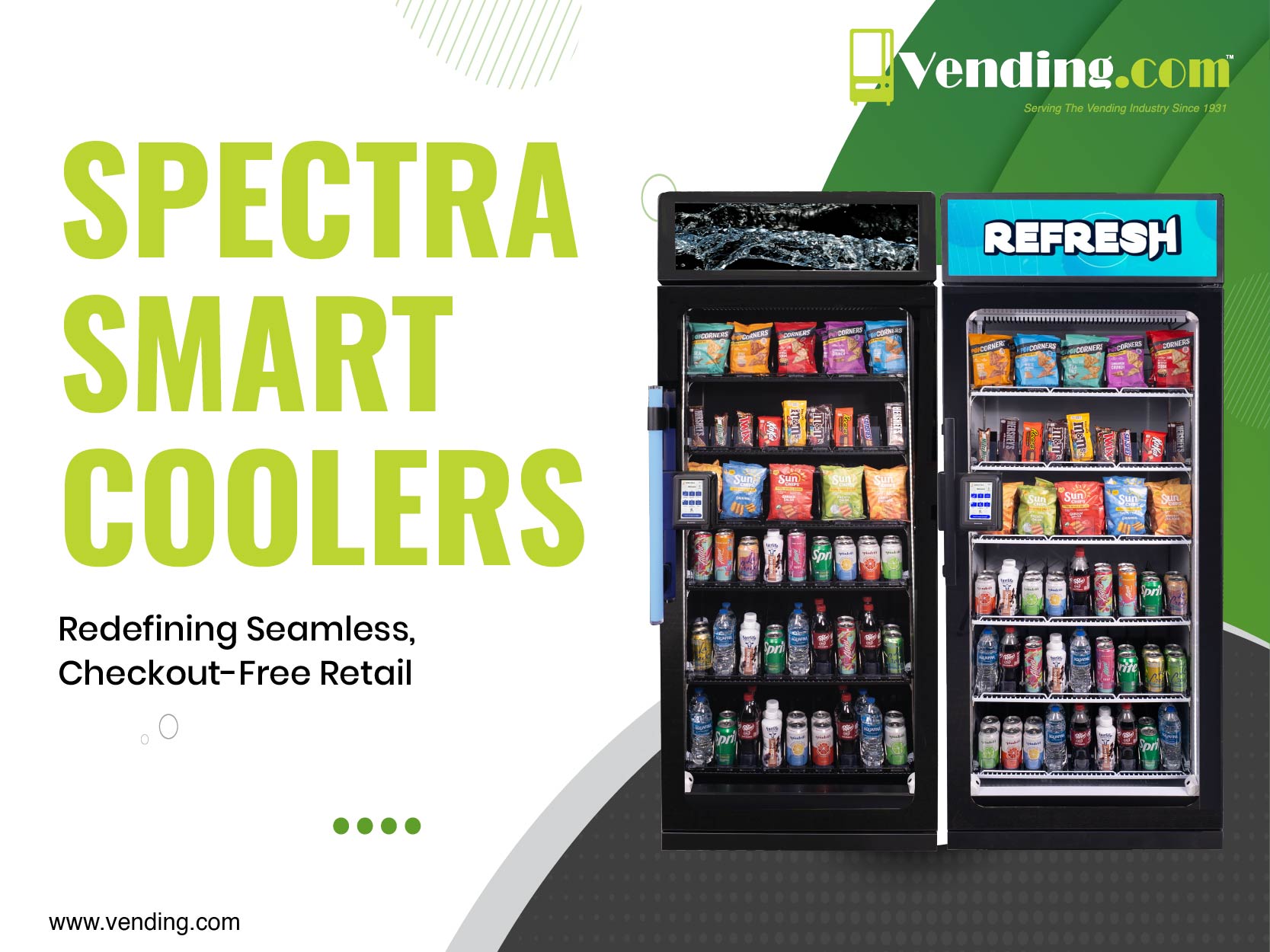
Spectra smart coolers, powered by True AI product detection, are designed with that goal in mind. By eliminating the need for scanning or staffed checkout, Spectra coolers make the entire purchase process effortless. Customers scan their card to open the cooler, take what they want, and go—while AI-powered technology handles product detection and billing automatically.
For operators, that simplicity on the front end drives real results on the back end. Faster transactions increase throughput. Fewer manual steps reduce errors. Lower reliance on on-site staff helps control costs. And a smoother experience encourages repeat use. It’s a solution built to make retail easier to manage, more efficient to run, and better aligned with what today’s customers expect.
The Shift Toward Truly Frictionless Retail
Traditional self-checkout kiosks were introduced to reduce labor and improve efficiency, but in practice, they often shift the burden onto the customer. Shoppers still need to scan each item, follow on-screen prompts, and complete multiple steps before they can leave. In low traffic, that may be manageable—but at scale, it slows the pace of transactions, creates congestion, and limits how smoothly a location can operate.
That’s why the focus is shifting beyond incremental improvements. Rather than refining outdated workflows, AI-powered systems are removing those steps entirely by replacing manual interaction with automation that works instantly and in the background. Spectra smart coolers, powered by True AI product detection, represent this next phase, where checkout isn’t improved, but rather, it’s eliminated to create a faster, more efficient model for both customers and operators.
What Makes Spectra™ Smart Coolers Different
The Spectra experience is intentionally simple, designed to feel natural rather than transactional. Customers open the cooler, select what they want, and close the door without stopping to scan items or navigate a checkout interface.
Spectra smart coolers, powered by True AI product detection, take a fundamentally different approach to automated checkout. While many smart coolers on the market claim to use AI, they often rely on delayed processing or human review behind the scenes. That delay can leave customers unsure of what they’ve been charged and limit how quickly operators can access transaction data.
Spectra smart coolers remove that gap. Product detection happens through a real-time shopping cart, allowing customers to see exactly what they’ve selected as they shop. Individual product pricing and total cost update dynamically, giving users full visibility into their purchase before the transaction is finalized. For operators, transactions are recorded immediately and reflect exactly what was taken, creating a clearer, more reliable view of sales and inventory.
Scalable Solutions for Every Environment
Not every location operates the same way and scaling a retail footprint shouldn’t mean adding complexity. As operators expand into new environments, the challenge is maintaining consistency while adapting to different traffic levels, space constraints, and staffing realities.
Spectra smart coolers are built to support that shift. Whether placed in a small office, a breakroom, or a high-traffic public space, the same checkout-free experience carries through without requiring additional labor or operational oversight. In unattended environments, that consistency becomes critical. Operators need confidence that each unit will perform reliably, track every transaction accurately, and continue running without constant intervention.
Ready to Deliver a Seamless Retail Experience?
The Spectra smart cooler line brings together everything today’s operators need to run more efficient, scalable retail environments. From simplifying the customer experience to providing real-time transaction visibility and supporting unattended locations, Spectra is designed to remove the barriers that slow operations down and limit performance. The result is a smarter, more controlled way to manage sales, inventory, and growth across any environment.
Smart Cooler vs. Micro Market: Choosing the Right Model for Each Location
The conversation around unattended retail has evolved. Facility directors, procurement teams, and operations leaders are no longer debating if self‑service food and beverage access makes sense; that decision is already settled.
The real challenge now is sharper: which format delivers the best operational and financial outcome for each location?
Choosing the wrong model doesn’t just mean a poor fit. It can lead to underperforming revenue, wasted CAPEX, higher labor costs, and frustrated customers. The right choice, on the other hand, unlocks scalable growth, stronger ROI, and a smoother customer experience.
That’s why comparing smart coolers and micro markets isn’t about preference; it’s about aligning each format to the realities of your site profile, traffic patterns, and operational goals.
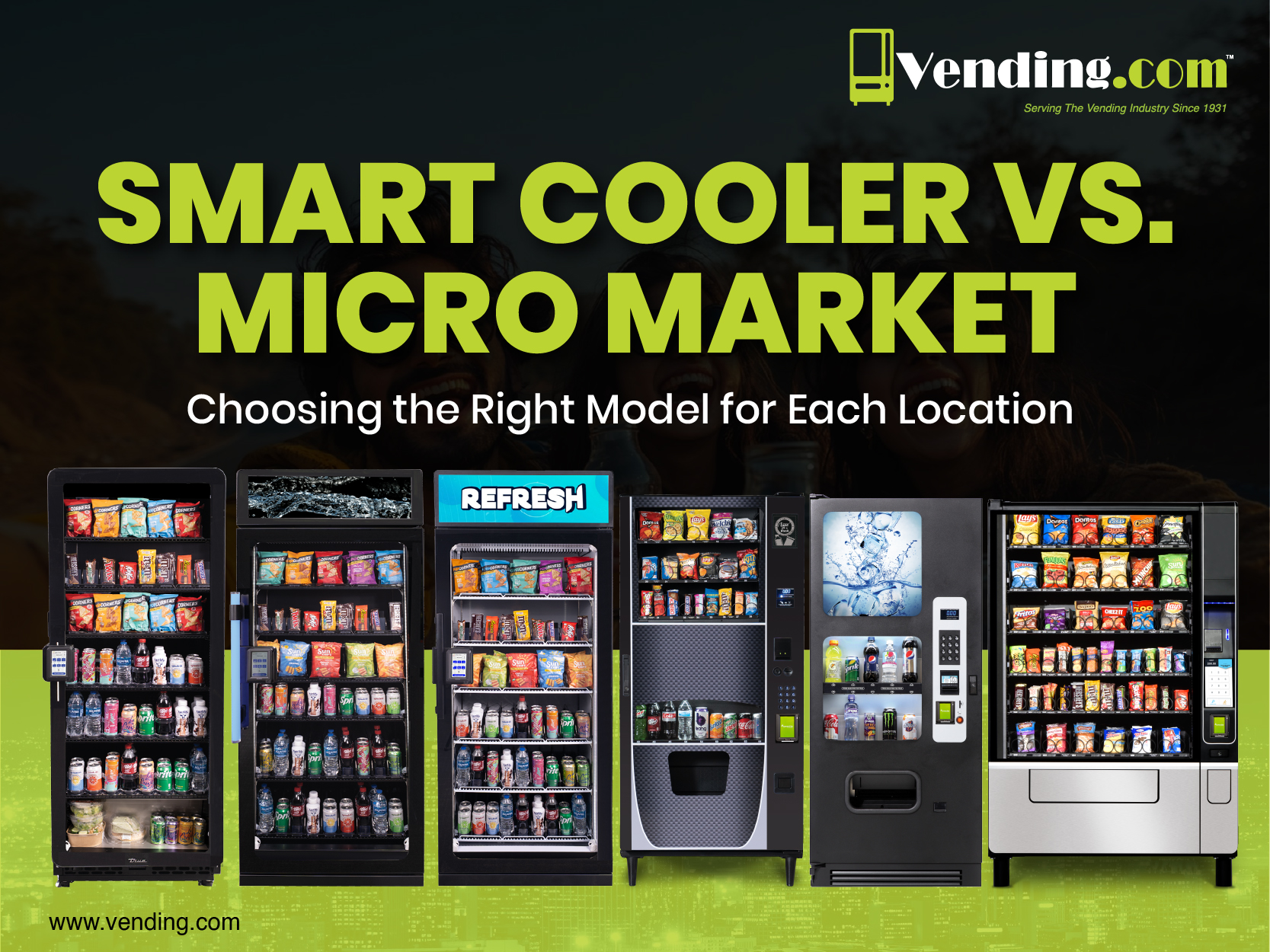
Smart coolers and micro markets are both strong models. They serve different site profiles, different traffic patterns, and different operational environments. Choosing the right unattended retail technology is what separates high-performing deployments from expensive underperformers.
Unlocking Grab-and-Go Profitability with AI-Powered Smart Coolers
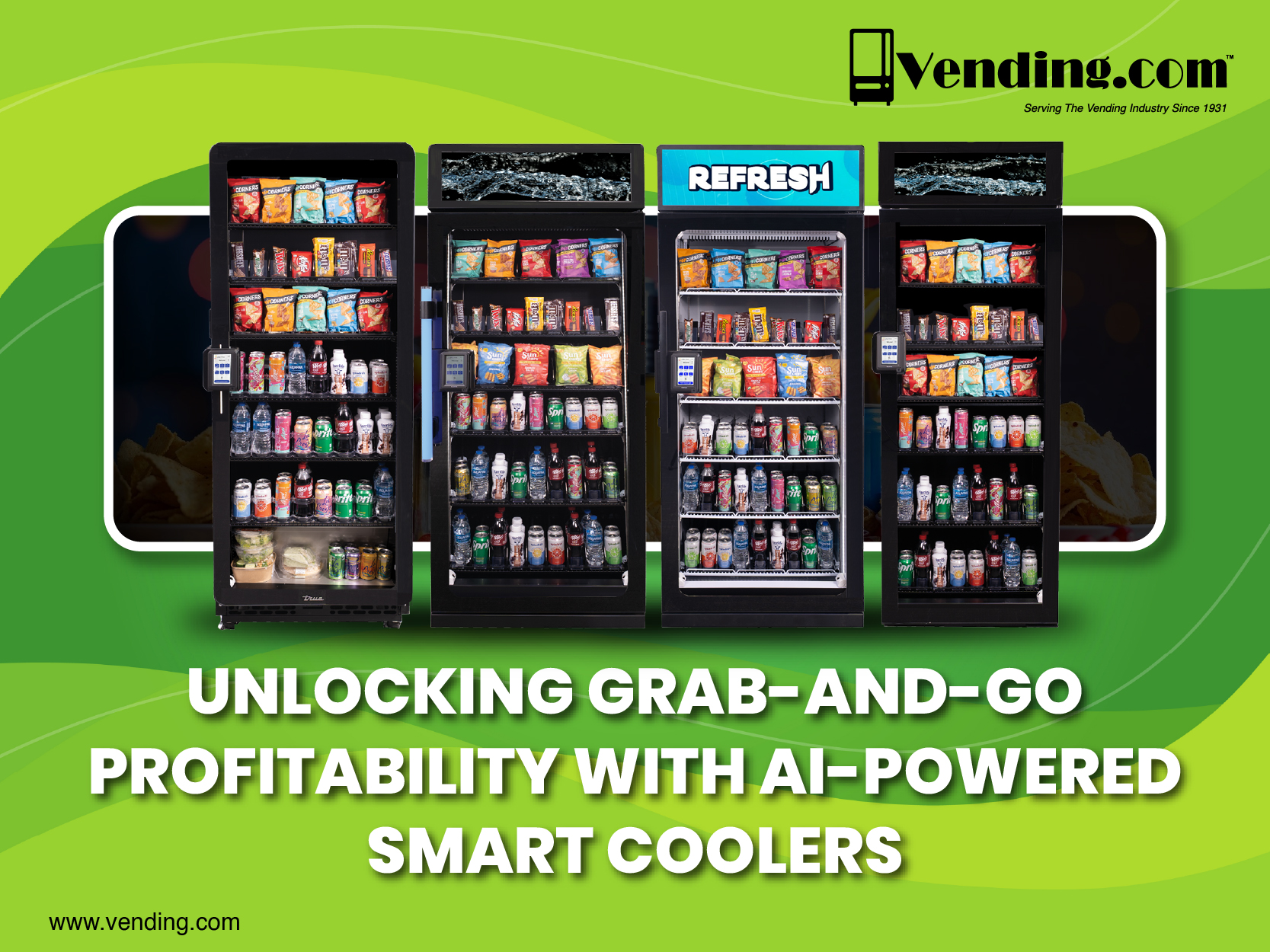
Grab‑and‑go retail is evolving, and traditional vending machines struggle to keep up with modern customer expectations. Shoppers want cashless payments, frictionless checkout, and the ability to interact with products before purchase physically. That’s why businesses are increasingly turning to AI-powered smart coolers like the Spectra Launch AI Smart Cooler from Vending.com, a solution designed to deliver convenience, security, and profitability at scale.
Meet Your Smartest Hire Yet: The Spectra Launch AI Smart Cooler
Imagine an employee who never calls in sick, works 24/7, improves customer satisfaction, and drives revenue. With the Spectra Launch AI Smart Cooler, that’s no longer just an idea. It’s a smarter way to modernize grab-and-go retail.
Powered by True AI computer vision, the Spectra Launch transforms everyday snack and beverage sales into a seamless unattended retail experience, automatically recognizing products with 99%+ accuracy.
But this isn’t just another smart cooler; it’s a complete retail solution designed to help operators reduce labor costs, improve inventory visibility, and maximize profitability without adding complexity.
In this blog, we’ll explore why the Spectra Launch is becoming the smart hire businesses rely on to scale, maximize sales, lower operational costs, and stay competitive.
How AI Smart Coolers Turn Unused Space Into 24/7 Revenue
Did you know unattended retail solutions can turn underutilized spaces into consistent revenue generators? Vending.com’s Spectra AI Smart Coolers are designed to maximize sales, reduce labor costs, and deliver a frictionless shopping experience.
What Is a Smart Cooler? (And How AI Checkout Actually Works)
Imagine grabbing a fresh salad at midnight in your apartment lobby, no cashier, no scanning, no waiting. You unlock the cooler, take what you want, and walk away. That’s the promise of AI checkout in unattended retail: convenience for customers, efficiency for operators, and scalability for businesses.
Smart coolers are more than vending machines. They’re smart vending solutions powered by AI computer vision, cashless payments, and real-time inventory tracking, designed to deliver fresh-food convenience in offices, hospitals, universities, and beyond.
Navigate the Smart Cooler Selection Guide:
Why businesses invest in AI smart coolers – benefits for operators and customers
Smart cooler vs vending machine – key differences in experience and variety
How AI checkout works – step‑by‑step shopping and payment process
Technology powering smart coolers – vision, payments, monitoring, and reporting
Fresh food convenience – refrigerated assortments that drive higher sales
Choosing the right Spectra model – Launch, Core, Pro, and Elevate explained
Security and scalability – asset protection and multi‑location management
Investment and financing – ROI potential and flexible deployment options
Future of unattended retail – how AI smart coolers are reshaping convenience
Why Businesses Are Investing in AI Smart Coolers
Consumer expectations have shifted toward grab-and-go convenience and cashless payments, while businesses face rising labor costs. Smart coolers bridge this gap by offering:
Larger average transactions
Expanded fresh food sales
Reduced staffing needs
Better inventory visibility
Improved customer experience
The above combination makes smart coolers a compelling choice for operators in unattended retail environments such as offices, apartments, healthcare facilities, and universities.
Smart Cooler vs. Traditional Vending Machine: Which Delivers More Value?
Feature
Traditional Vending Machine
AI Smart Cooler
Shopping Experience
Keypad selection
Browse products naturally
Product Variety
Limited
Flexible shelving & assortments
Fresh Food Sales
Minimal
Designed for refrigerated products
Multiple Item Purchases
Less convenient
Simple grab-and-go
Cashless Payments
Optional
Standard feature
Inventory Visibility
Limited
Real-time management
Remote Monitoring
Varies
Built-in
Customer Experience
Transactional
Retail-style
Smart coolers deliver a retail‑style shopping experience that vending machines can’t match. By combining AI product detection, real‑time inventory visibility, and cashless checkout, they transform unattended retail into a scalable, modern solution. For operators, this means higher basket sizes, fresher assortments, and stronger ROI compared to traditional vending.
How AI Smart Coolers Work and Why It Matters for Operators
The process feels seamless to customers, but behind the scenes:
Unlocking the Cooler – Authenticate with card or mobile wallet.
AI Tracks Product Selection – Computer vision detects items that are removed or returned.
Automatic Checkout – Payment processes, inventory updates, and transaction data records are automatic.
This AI checkout experience feels closer to a convenience store than a vending machine.
Technology Behind Smart Coolers – Powering Efficiency and Security
Smart coolers combine multiple technologies to create a seamless unattended retail experience:
AI Computer Vision for product recognition.
Cashless Payment Systems for modern transactions.
Remote Monitoring for operators.
Inventory Management to prevent stockouts.
Cloud-Based Reporting for smarter decisions.
Security Features, including locks, cameras, and theft alerts.
Supporting Fresh Food Sales – How Smart Coolers Expand Variety
Fresh food is one of the fastest-growing categories in unattended retail. Smart coolers support sandwiches, salads, protein snacks, yogurt, and grab-and-go meals, meeting consumer demand for healthier, fresher options.
This flexibility allows operators to expand beyond traditional vending, offering fresh food convenience that boosts customer satisfaction and sales.
Smart coolers include authentication, smart locks, cameras, and real-time monitoring. Advanced models add GPS asset tracking and theft alerts. Scalability features like cloud-based reporting and centralized management make multi-location deployment seamless.
Why Smart Coolers Are Worth Your Investment
Smart coolers deliver more than product sales:
New revenue streams
Customer convenience
Fresh food expansion
Reduced staffing
24/7 access
Financing options help operators preserve capital and expand faster.
Stay Ahead of Customer Expectations
AI smart coolers are transforming how businesses deliver food, beverages, and convenience products. By combining AI checkout, refrigerated storage, cashless payments, remote monitoring, inventory management, and advanced security, they create a modern retail experience that benefits both customers and operators.
Ready to explore AI smart coolers for your business? Get a quote today and see how Spectra can deliver fresh food convenience, secure unattended retail, and scalable ROI.
FAQs on Smart Coolers
1. How do AI smart coolers work?
AI smart coolers use computer vision and product recognition technology to track items as customers interact with them. Once a shopper authenticates with a card or mobile wallet, the cooler unlocks. Customers can browse naturally, remove or return items, and the system updates a virtual cart in real time. When the door closes, payment is processed automatically, inventory is updated, and transaction data is recorded, creating a frictionless AI checkout experience.
2. Can smart coolers track inventory automatically?
Yes. Smart coolers include real-time inventory management tools that monitor stock levels and sales activity. Operators can quickly identify which products need restocking, reduce waste, and prevent stockouts. Cloud-based dashboards make it easy to manage multiple locations, ensuring consistent product availability across sites.
3. Do smart coolers accept mobile payments?
Absolutely. Smart coolers are designed for cashless convenience. They support credit cards, debit cards, contactless payments, and mobile wallets such as Apple Pay and Google Pay. This flexibility appeals to modern consumers who expect fast, secure, and mobile-first purchasing options.
4. Do smart coolers need internet access?
Yes. Internet connectivity is required for secure payment processing, remote monitoring, inventory tracking, and reporting. Many models use cellular connectivity, making them easy to deploy even in locations without Wi-Fi. Connectivity ensures operators can monitor cooler performance and access sales data anytime.
5. What products sell best in refrigerated smart coolers?
Smart coolers are built for fresh food convenience. Popular categories include sandwiches, salads, yogurt, protein snacks, fruit cups, bottled beverages, and healthy grab-and-go meals. Offering a wider variety than traditional vending machines helps meet consumer demand for healthier, fresher options.
6. How secure are AI smart coolers?
Modern smart coolers include customer authentication, smart locks, security cameras, and transaction monitoring to reduce theft and protect assets. Advanced models add GPS tracking and theft alerts, giving operators confidence to deploy coolers in busy or sensitive environments.
7. What is the difference between a smart cooler and a vending machine?
Traditional vending machines dispense products one at a time through a mechanical system. Smart coolers, by contrast, allow customers to browse refrigerated shelves, select multiple items in one transaction, and enjoy a retail-style shopping experience. They also provide real-time inventory visibility and cashless payments as standard features.
8. Are AI smart coolers suitable for multiple locations?
Yes. Smart coolers are designed for scalability. With cloud-based monitoring, centralized reporting, and automated inventory visibility, operators can efficiently manage multiple sites. This makes them ideal for corporate campuses, apartment communities, healthcare facilities, and universities.
How Smart Coolers Transform Gyms, Apartment Communities, and Shared Spaces
In today’s gyms, apartments, and shared spaces, every square foot counts. Facility managers, property owners, and operators are under pressure to deliver modern amenities without expanding retail footprints or increasing staffing costs.
The challenge is clear: how do you provide convenient access to food and beverages while controlling labor, maximizing space, and maintaining efficiency?
Smart coolers solve this challenge by combining unattended retail technology, cashless payments, remote monitoring, and AI-powered checkout into one compact solution. They enable 24/7 access to snacks, beverages, fresh food, and wellness products, all without the overhead of staffing a retail location.
For decision-makers, this means more than convenience. It means new revenue opportunities, enhanced user experiences, and improved operational efficiency.
Why Shared Spaces and Communities Are Embracing AI-Powered Smart Coolers
Organizations want to provide convenient access but face challenges: limited staffing, rising labor costs, underutilized areas, and demand for 24/7 amenities.
Smart coolers offer a practical middle ground for self-service retail, with remote monitoring, cashless transactions, and AI-powered checkout. Customers enjoy seamless access, while operators maintain visibility and control without added workload.
Consumer demand for convenience – Today’s consumers expect instant access to food and beverages without waiting in line or depending on staff availability.
Why traditional retail isn’t practical – Staffed cafés or full micro markets often struggle in shared environments where traffic is unpredictable, and staffing costs outweigh revenue potential. Smart coolers solve this by offering a compact, unattended retail solution that scales to demand, reduces overhead, and keeps operations efficient.
By combining unattended retail technology with consumer-driven convenience, smart coolers transform shared spaces into modern amenities that generate revenue without the complexity of traditional retail formats.
Smart Coolers for Gyms and Fitness Centers
Fitness centers and gyms thrive when members feel supported. Smart coolers deliver:
Incremental revenue from wellness products like hydration, protein drinks, and healthy snacks.
Extended service hours so members can shop anytime, even when staff isn’t available.
Reduced operational burden through automated checkout.
Higher member satisfaction thanks to convenient access that supports retention.
Optimized use of space with compact coolers that fit seamlessly into lobbies or lounges.
Popular Product Categories
Protein shakes
Recovery beverages
Bottled water
Energy drinks
Healthy snacks
Real‑World Example
A fitness center can place a smart cooler near the exit to offer hydration drinks, protein shakes, and recovery snacks to members after workouts. This setup generates incremental revenue while enhancing the member experience, all without requiring additional staffing.
Smart coolers transform gyms into spaces where convenience directly drives loyalty and revenue.
Smart Coolers for Multifamily Housing, Apartments and Residential Communities
Today’s residents expect amenities that support convenience, flexibility, and accessibility.
Smart coolers provide a modern amenity without the investment and complexity of a full convenience store or micro market.
Greater amenity value with on‑demand access to essentials.
Enhanced resident experience through modern, self‑service convenience.
Labor‑free operations with transactions handled automatically.
Better use of common areas by converting lobbies or clubhouses into valuable retail points.
Property differentiation with tech‑driven amenities that boost retention.
Resident Retention and Leasing Advantages
Smart coolers don’t just add convenience; they directly impact occupancy and leasing. Properties that offer modern, tech‑driven amenities stand out in competitive markets, helping attract new residents and retain existing ones.
Amenity Differentiation
Smart coolers provide a unique amenity that sets communities apart from competitors, signalling innovation and resident‑first thinking.
Real‑World Example
Residents can access beverages, quick meals, and household essentials from a smart cooler located in the clubhouse or lobby. This creates a convenience‑store experience without dedicating significant space or labor resources, while simultaneously boosting resident satisfaction and property value.
Smart Coolers for Community and Shared Spaces
Community spaces often experience fluctuating traffic patterns that make traditional retail difficult to sustain.
Whether it’s a coworking facility, recreation center, employee lounge, student commons, or shared gathering area, operators need flexible solutions that can adapt to changing demand.
Efficient service for variable demand without staffed operations.
New revenue streams from spaces that might otherwise sit idle.
Flexibility to serve diverse groups of employees, residents, visitors, or students.
Remote performance monitoring with cloud based tools.
Scalable deployment across multiple facilities with centralized control.
Real‑World Example
A coworking facility can place a smart cooler in its shared lounge, offering coffee, grab‑and‑go meals, healthy snacks, and beverages to professionals throughout the day. This creates a convenient amenity that supports productivity, generates incremental revenue, and adapts seamlessly to fluctuating traffic without requiring staffed retail operations.
Why Smart Coolers Make Sense Across These Settings
While gyms, residential communities, and shared spaces serve different audiences, their operational goals are often similar:
Increase Revenue Potential – Turn underutilized space into an additional revenue stream.
Optimize Space Utilization – Deploy retail capabilities without dedicating large footprints to traditional retail formats.
Why Spectra™ AI Smart Coolers Stand Out
Spectra™ AI Smart Coolers combine advanced technology with a frictionless shopping experience designed for modern unattended retail environments.
Key capabilities include:
True AI™ computer vision technology – Enables a frictionless grab‑and‑go experience while helping improve transaction accuracy.
Real‑time transaction verification – Reduces discrepancies and supports stronger inventory control and revenue protection.
Cashless payments – Deliver faster checkout experiences and align with modern consumer payment preferences.
Remote monitoring and inventory visibility – provide operators with actionable insights to optimize inventory, reduce service visits, and improve operational efficiency.
Fresh food and beverage support – Expands product offerings and unlocks higher‑revenue opportunities beyond traditional packaged snacks.
Flexible merchandising capabilities – Allow operators to adapt product assortments based on customer preferences, seasonal demand, and location needs.
Scalable deployment across multiple locations – Supports consistent operations and centralized management as unattended retail programs grow.
Bring Smart Retail to Your Location
Ready to transform underutilized space into a revenue‑generating amenity? Spectra™ AI Smart Coolers help gyms, apartment communities, and shared facilities provide 24/7 convenience, reduce labor requirements, and create new revenue opportunities. With AI‑powered checkout, cashless payments, and remote monitoring, operators gain modern amenities that boost satisfaction while maintaining operational control.
Contact Vending.com today to explore unattended retail solutions, financing options, and discover how Spectra™ AI Smart Coolers can help you grow confidently.
Spectra AI Smart Coolers vs. Other Smart Coolers: Why Real-Time Intelligence Matters
You invested in a smart cooler to simplify operations. Instead, you’re stuck reviewing flagged transactions, reconciling mismatched inventory, and handling disputes days later. That’s the hidden reality of platforms that rely on delayed or human-reviewed processing.
The issue isn’t smart-cooler technology itself; it’s the design choice. When verification happens hours after the customer leaves, operators face shrinkage, labor overhead, and frustrated customers. The Spectra AI Smart Cooler from Vending.com eliminates that gap with True AI™ computer vision and real-time transaction confirmation.
In This Guide:
The Hidden Problem with Most Smart Coolers for Business
How Do AI Smart Coolers Work? Real-Time vs. Delayed Review
Hidden Costs of Operating a Smart Cooler
What Technology Powers the Spectra AI Smart Cooler?
Why the Spectra AI Smart Cooler Delivers Better ROI for Unattended Retail Operators
Frequently Asked Questions About AI Smart Coolers
Real-Time AI vs. Delayed Review: What It Actually Means for Your Operation
The table below highlights the practical differences between real-time AI verification and delayed or human‑review systems. It shows how each approach impacts transaction speed, inventory accuracy, dispute resolution, labor dependency, shrinkage exposure, and restocking decisions.
What It Affects
Spectra AI Smart Cooler
Delayed / Human Review
Transaction confirmation
Immediately, at session close
Post-session, minutes to hours later
Inventory tracking
Automatic, near real-time
Delayed; requires reconciliation
Dispute resolution
Faster, charge matches session
More complex once the customer has left
Labor dependency
Low, the system handles verification
Higher staff needed for audits
Shrinkage exposure
Reduced (4 cameras included)
Larger window for loss
Restocking decisions
Data-driven, on demand
Based on delayed or incomplete data
Hidden Costs of Operating a Smart Cooler that Most Buyers Miss
When calculating smart cooler costs, buyers often focus only on equipment price and financing. But monthly operating costs vary widely depending on the type of system.
Delayed‑review systems: These are platforms where transactions are flagged and reviewed minutes or even hours after the customer leaves. Because verification isn’t instant, operators must rely on audits, reconciliations, and dispute handling. These tasks do not scale efficiently with higher transaction volume, creating labor overhead and operational bottlenecks.
Real‑time AI systems: These platforms confirm transactions instantly at the point of purchase. Inventory updates automatically, disputes are minimized, and there are no review queues. This reduces labor dependency and makes scaling across multiple locations far easier.
For small businesses, the difference is critical: delayed‑review systems often push deployments toward break‑even, while real‑time AI systems make profitability and growth achievable.
What Technology Powers the Spectra AI Smart Cooler?
The Spectra unit integrates AI and IoT into a single, low‑maintenance platform, each feature designed to reduce operator workload, improve accuracy, and maximize ROI:
True AI™ Computer Vision – 99%+ detection accuracy, no human review. Benefit: Eliminates manual audits and dispute handling, saving labor costs.
Real‑Time Shopping Cart – Customers see charges before closing the door. Benefit: Reduces billing disputes and improves customer trust.
Cashless Payments – Cards, mobile wallets, tap‑to‑pay. Benefit: Speeds up checkout and supports modern, frictionless transactions.
4 Security Cameras – Theft deterrence and transaction confidence. Benefit: Lowers shrinkage risk and provides verifiable transaction records.
Built‑In Cellular Router – Auto‑connects to AT&T, Verizon, T‑Mobile. Benefit: Ensures reliable uptime without relying on venue Wi‑Fi.
541‑Item Capacity – Six customizable shelves, reduced restocking. Benefit: Increases product variety and lowers restocking frequency.
Remote Monitoring – Cloud‑connected inventory and performance data. Benefit: Enables data‑driven restocking and operational visibility across locations.
PCI & GDPR Compliance – Secure transactions and privacy standards. Benefit: Protects customer data and ensures regulatory compliance.
Temperature Safety Lock – Activates if temperatures exceed 41°F. Benefit: Safeguards product quality and prevents spoilage liability.
3‑Year Warranty + Lifetime Support – With $0 down financing available. Benefit: Reduces ownership risk and provides long‑term reliability with flexible financing.
Why the Spectra AI Smart Cooler is the Right Investment for Your Unattended Retail Business
Most platforms shift audit, dispute, and reconciliation work onto your team. That overhead includes:
Reviewing flagged transactions after customers have left.
Reconciling mismatched inventory counts.
Handling billing disputes manually.
Scheduling staff time for audits and restocking based on incomplete data.
Transactions close instantly – no post‑session review queues.
Inventory updates automatically – operators see real‑time stock levels.
Disputes are minimized – customers confirm charges before closing the door.
Cellular connectivity ensures uptime – no reliance on venue Wi‑Fi.
High capacity reduces labor costs – fewer restocking trips, more efficient operations.
That’s the difference between a cooler you manage and one that manages itself.
Take the Next Step
Ready to see the numbers for your location? Call 855-966-1642 or request a personalized quote to explore how the Spectra AI Smart Cooler can support your long-term unattended retail growth strategy.
FAQs
Do smart coolers accept mobile payments?
Yes. The Spectra AI Smart Cooler accepts credit and debit cards, mobile wallets, and tap-to-pay through an integrated cashless payment reader. No app or account needed.
Can smart coolers track inventory automatically?
Yes, and accuracy matters. The Spectra AI Smart Cooler updates inventory in near real time using True AI™ computer vision, enabling data-driven restocking decisions without manual counts.
Do smart coolers need internet access?
Yes, but the Spectra AI Smart Cooler doesn’t rely on venue Wi-Fi. It’s built-in cellular router automatically connects to the best available signal from AT&T, Verizon, and T-Mobile.
Are smart cooler financing options available?
Yes. Vending.com offers financing for qualified buyers (WAC). Call 855-966-1642 or apply online.
“If customers can open the cooler, take products, and walk away without a cashier, how do you know what they took?”
That sounds like a security risk. So how does an unattended cooler know what a customer took, whether they paid for it, and what to do when something doesn’t add up?
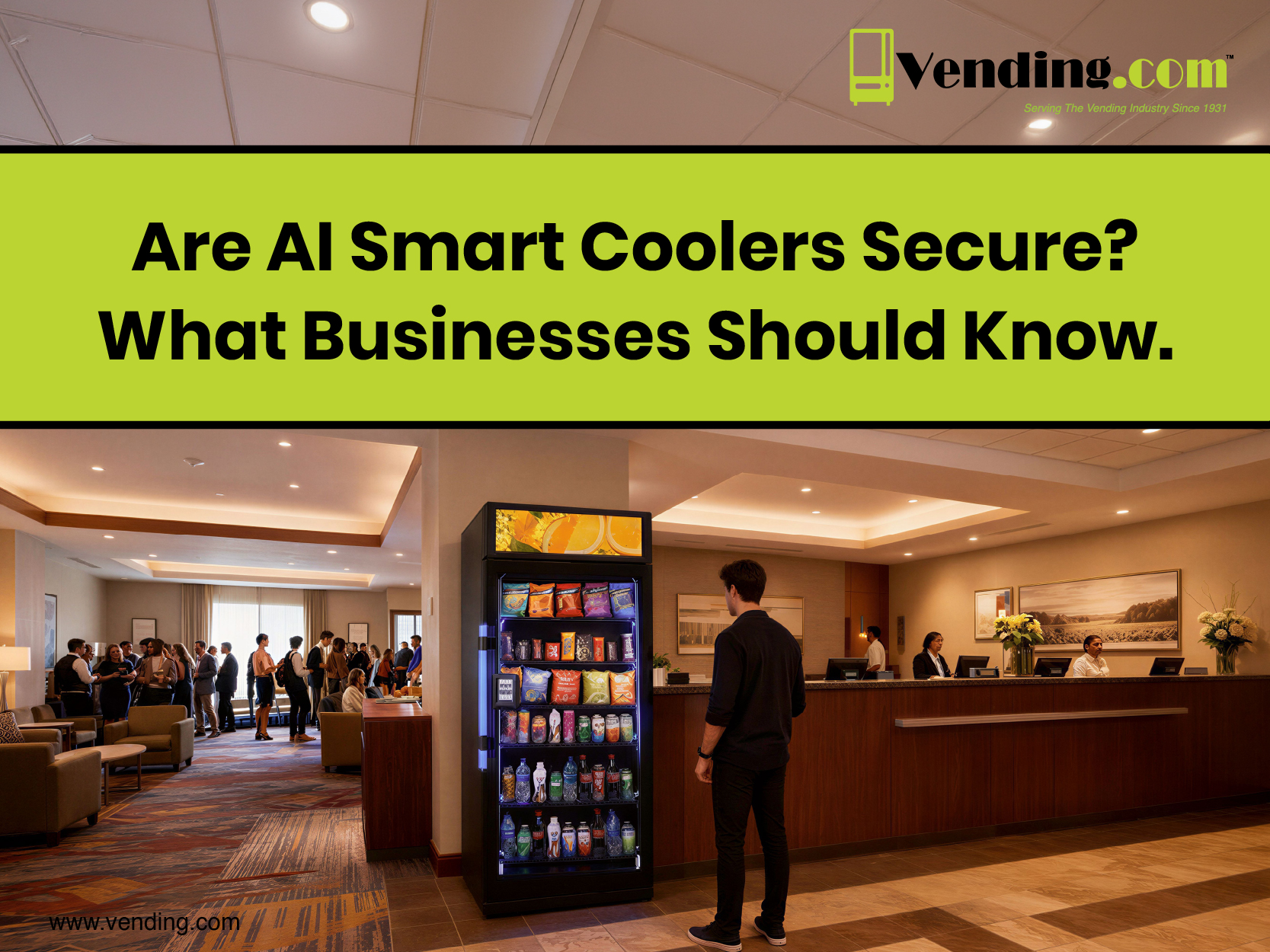
AI smart coolers address these challenges by combining several technologies: controlled access, computer vision, cashless payments, physical locks, transaction tracking, alerts, and remote monitoring.
But “AI-powered” does not automatically mean “secure.”NIST’s AI Risk Management Framework treats security, resilience, privacy, transparency, and accountability as separate considerations when evaluating AI systems.
Are AI Smart Coolers Actually Secure?
Yes, AI smart coolers can be secure when layered controls, access, product recognition, payments, and monitoring work together.
A useful way to evaluate smart cooler security is to look at the complete transaction:
Access Control
Product Recognition
Transaction Verification
Payment Security
Physical Security
Monitoring and Alerts
Data Protection
Access controls determine who can open the cooler. Computer vision can identify merchandise as it moves. Payment technology links the purchase to a transaction, while physical security and monitoring add protection and visibility.
The key is to evaluate what the specific smart cooler actually supports rather than assuming every AI system has the same security capabilities.
What Makes an AI Smart Cooler Secure?
1. Controlled Customer Access
Security starts before you remove a product. Depending on the system, customers may authenticate using a payment method before the cooler unlocks. This links the person accessing the equipment to the transaction.
Before deploying a smart cooler, businesses should understand:
How customers authenticate
How access is controlled
Whether access events are recorded
What happens when authentication fails
How the system handles connectivity interruptions
A controlled access process creates the first layer of accountability in an unattended transaction. This process is a critical smart cooler theft prevention measure because it ensures accountability before any product leaves the cooler.
2. AI Product Recognition
Once the cooler is open, the system needs to understand what is being removed.
Spectra Pro uses True AI™ Computer Vision Product Recognition to identify products and a real-time smart shopping cart to track selections. Vending.com positions the technology as a way to reduce shrink, eliminate manual tracking, and support transaction accuracy.
Spectra Core also uses True AI™ Computer Vision Product Recognition and real-time shopping cart technology.
This creates a digital record connecting product movement with the customer’s transaction.
One important distinction: computer vision for product recognition is not automatically facial recognition. A system can use computer vision to identify merchandise without identifying a customer’s face. Product-recognition systems are designed to identify merchandise and transaction activity, not necessarily individual customer identities.
How Does an AI Smart Cooler Prevent Theft?
No unattended retail system can guarantee zero theft. Instead, AI smart cooler theft prevention relies on multiple controls working together. Product recognition can identify what was removed, transaction systems can connect those items to a purchase, and security and monitoring features can help operators investigate unusual activity.
See Spectra Pro in Action
Spectra Pro provides a practical example of this layered approach. Its AI product detection, real-time shopping, live sales data, alerts, and remote diagnostics give operators greater visibility into transactions and machine activity.
Spectra Pro also includes cloud-based VMS monitoring and a NAMA-compliant smart lock designed to protect inventory.
Other Spectra models add different security capabilities. Spectra Launch, for example, includes four integrated security cameras, a NAMA-compliant smart lock, and theft and abnormal-order alerts. Spectra Elevate includes real-time theft alerts, GPS asset tracking, cloud-based monitoring, and a NAMA-compliant smart lock.
The goal isn’t to claim that theft cannot happen. It is to make product movement more visible, transactions more traceable, and potential discrepancies easier to investigate.
How Does Payment Security Work?
Physical security is only part of the equation. The payment transaction also needs protection.
Payment security is particularly important for unattended retail because payment terminals capture and process card data. PCI Security Standards Council requirements cover unattended payment terminals and the environments in which payment data is processed.
AI smart coolers generally use cashless payment systems that connect customer authentication, product selection, and payment into a digital transaction.
Businesses evaluating a system should ask about:
EMV and contactless payment support
Payment authentication
PCI compliance
Transaction records
Payment processing
Refund and dispute procedures
Spectra Pro supports cashless payments and states that its transactions are PCI compliant. Spectra Core supports cashless payments through WeVend or Cantaloupe card readers and states that it provides full PCI compliance for secure cashless transactions.
Businesses should still clarify which components and processes the stated PCI compliance covers and how it handles payment information. Secure, PCI-compliant transactions protect customer trust and reduce operator liability.
How Does Computer Vision Track a Transaction?
The value of computer vision isn’t simply identifying an item. It is connecting physical product movement with the digital transaction.
A typical AI smart cooler transaction may work like this:
The customer authenticates.
The cooler unlocks.
Products are removed.
The system detects the product movement.
The shopping cart updates.
Products can be returned or changed.
The customer closes the door.
The transaction is finalized.
This reduces the need for manual product tracking and provides operators with more detailed transaction information.
It can also make inventory reconciliation easier because operators can compare product movement and sales data instead of relying entirely on manual counts.
What Happens If AI Makes a Mistake?
When errors occur, such as incorrect product recognition or disputed charges, operators need clear exception-handling processes. Strong systems allow remote review, correction, and dispute resolution.
Potential issues can include:
A product being incorrectly identified
Multiple products being removed together
An item being returned
Products being positioned differently
An item not being recognized
A disputed charge
An inventory mismatch
The important question isn’t simply “How accurate is the AI?”
Businesses should also ask:
Can operators review individual transactions?
How are disputed purchases investigated?
What happens when a product cannot be identified?
How are corrections or returns handled?
Can inventory discrepancies be investigated remotely?
A strong unattended retail system needs a process for what happens when the technology encounters something unexpected.
How Are Products Physically Protected?
Digital tracking works alongside physical security.
Smart Locks
Smart locks can restrict physical access to the cooler. Spectra Pro, Core, Launch, and Elevate list NAMA-compliant smart locks as a security feature.
Security Cameras
Camera capabilities vary by model. Spectra Launch includes four integrated security cameras.
Businesses should determine what cameras are used for, whether they support security monitoring or another function, and how associated image or video data is handled.
Remote Monitoring and Alerts
Connected systems can give operators visibility without requiring someone to stand beside the cooler.
Depending on the model, capabilities can include cloud-based monitoring, theft alerts, abnormal-order alerts, machine health information, and remote diagnostics.
That visibility can help operators identify issues and respond without waiting for a routine site visit.
How Does an AI Smart Cooler Reduce Shrink?
Shrink isn’t limited to theft. It can also result from transaction errors, damaged products, inaccurate inventory records, or operational issues.
By connecting product activity with sales and inventory data, AI smart coolers reduce unattended retail loss prevention challenges and improve restocking efficiency.
This can support:
Transaction reconciliation
Product movement tracking
Inventory visibility
Discrepancy detection
Remote monitoring
More informed restocking
Spectra Pro specifically positions AI product detection as a way to reduce shrink and eliminate manual tracking.
No universal smart cooler shrink rate applies across every location. Results can vary based on traffic, product mix, customer behavior, equipment, security configuration, and operating procedures.
For that reason, businesses should ask vendors for performance data from comparable locations.
Is Customer Data Safe?
Payment security and data privacy are separate issues. Before deploying an AI smart cooler, businesses should understand:
What customer data is collected
What transaction information is stored
Whether cameras record video
What computer-vision data is processed
Where data is stored
How long it is retained
Who can access it
Which third-party systems receive data
How software and security updates are managed
Businesses should ask: What data is collected, how long is it stored, who can access it, and which third parties receive it? These questions can help businesses identify the privacy and compliance requirements that may apply to their deployment.
What About Privacy with Spectra Systems?
Vending.com states that Spectra systems are engineered to meet GDPR-level privacy standards, while Spectra Pro product information describes its data privacy as GDPR-aligned.
Businesses should still ask specific questions about the data lifecycle, including what information is collected, where it is stored, how long it is retained, and who has access.
Do Smart Coolers Use Facial Recognition?
Not necessarily. Product-recognition computer vision can identify merchandise without identifying customers by face. However, businesses should confirm the capabilities of any system they consider and ask whether it uses facial recognition, biometrics, customer profiles, or video recording.
Are Smart Coolers More Secure Than Traditional Vending?
Smart coolers often provide real-time transaction tracking and remote monitoring, giving them an edge in AI vending machine security compared to traditional vending. But there isn’t a single answer because security capabilities vary across both traditional vending equipment and smart cooler systems.
The table below compares common traditional vending security features with capabilities available across the Spectra AI Smart Cooler portfolio.
Cashless payments via WeVend® or Cantaloupe® readers
Payment Security
Varies by payment system
PCI-compliant cashless transactions
Inventory Visibility
Typically verified during servicing or through VMS
Real-time inventory and transaction visibility through cloud-based VMS
Remote Monitoring
Available on connected machines
Cloud-based VMS monitoring across Spectra models
Security Cameras
Not typically included
Four integrated security cameras on Spectra Launch
Theft Alerts
Varies by equipment and software
Theft alerts available on Spectra Launch and Spectra Elevate
Abnormal Activity Alerts
Limited or software dependent
Abnormal-order alerts available on Spectra Launch
GPS Asset Tracking
Not typically available
Available on Spectra Elevate
Remote Diagnostics
Varies by machine and management platform
Available through cloud-connected Spectra management tools
Product Recognition Accuracy
Dispense verification only
AI-powered product recognition and detection technology
Data & Transaction Records
Standard sales data
Detailed transaction, inventory, sales, and activity reporting
Traditional vending remains a secure and effective unattended retail solution for many locations. Spectra AI Smart Coolers build on that foundation by adding AI-powered product recognition, real-time transaction tracking, cloud-based monitoring, alerts, and inventory visibility. These additional layers can help operators investigate discrepancies more efficiently and gain greater visibility into product movement and machine performance.
AI alone does not determine how secure a system is.
What Can Businesses Do to Improve Smart Cooler Security?
Technology works best when paired with sound operating practices.
Businesses can improve security by:
Placing equipment in an appropriate, visible location
Maintaining reliable connectivity
Keeping software and systems updated
Reviewing unusual transaction or inventory activity
Responding to security alerts
Establishing clear restocking procedures
Training operators on exception handling
Understanding technical support and escalation procedures
Connectivity is particularly important for connected equipment. Spectra Pro and Core support cellular connectivity as well as Wi-Fi/Ethernet, but businesses should still understand how authentication, transactions, monitoring, and alerts behave during an outage.
Key Takeaways
AI does not automatically make a smart cooler secure.
Security works in layers: access, product recognition, payments, locks, monitoring, and data practices.
Payment security matters: evaluate PCI compliance and authentication.
Product recognition is not the same as facial recognition.
Exception handling is essential.
Security varies by model: Spectra Pro, Core, Launch, and Elevate each offer different features.
Operations still matter: placement, connectivity, updates, and monitoring all contribute to security.
AI smart coolers can reduce theft, shrink, and liability when paired with strong operational practices and secure payment infrastructure.
Ready to Explore Secure Unattended Retail?
The right smart cooler depends on your location, products, customer needs, and operational requirements. Explore Vending.com’s unattended retail solutions and find the right fit for your next location.
FAQs
1.How do AI smart coolers prevent theft?
AI smart coolers can combine controlled customer access, computer vision, transaction tracking, smart locks, cameras on applicable models, alerts, and remote monitoring. Together, these controls can make product movement and transaction discrepancies easier to identify.
2.Can someone open an AI smart cooler without paying?
Access controls vary by system. Businesses should confirm how customers authenticate, whether access events are recorded, and what happens when authentication or payment fails.
3.Is payment information safe in an AI smart cooler?
Payment security depends on the payment system and configuration. Businesses should evaluate EMV support, authentication, PCI compliance, transaction records, and payment-data handling.
4.Do AI smart coolers use facial recognition?
Not necessarily. Computer vision can identify products without identifying a customer’s face. Businesses should ask specifically whether a system uses facial recognition, biometrics, customer profiles, or video recording.
5.What happens if an AI smart cooler identifies the wrong product?
The system should have an exception-handling process for incorrect product recognition, disputed purchases, returned products, and inventory discrepancies. Businesses should ask how operators can review and resolve these situations.
6.Do AI smart coolers have security cameras?
Camera capabilities vary by model. For example, Spectra Launch includes four integrated security cameras. Businesses should verify the capabilities and data practices of the specific model they are considering.
7.What happens if the internet goes down?
Connected smart coolers depend on their specific system architecture and connectivity setup. Businesses should ask how the system handles authentication, transactions, monitoring, and alerts during connectivity interruptions.
8.Are AI smart coolers more secure than traditional vending machines?
Security depends on the equipment and configuration. Traditional vending and AI smart coolers use different combinations of physical and digital controls. AI smart coolers can add capabilities such as computer vision, automated transaction tracking, remote monitoring, and alerts on applicable systems.
9.Are AI Smart Coolers Secure?
Yes. AI smart coolers can be secure when they combine layered controls such as customer authentication, AI-powered product recognition, transaction tracking, secure payment processing, physical security, monitoring, and data-protection practices. The overall security of a smart cooler depends on the technology, operating environment, payment infrastructure, and operational procedures supporting the deployment.
10.What Is PCI Compliance?
PCI compliance refers to security requirements designed to help protect payment-card data during storage, transmission, and processing.