
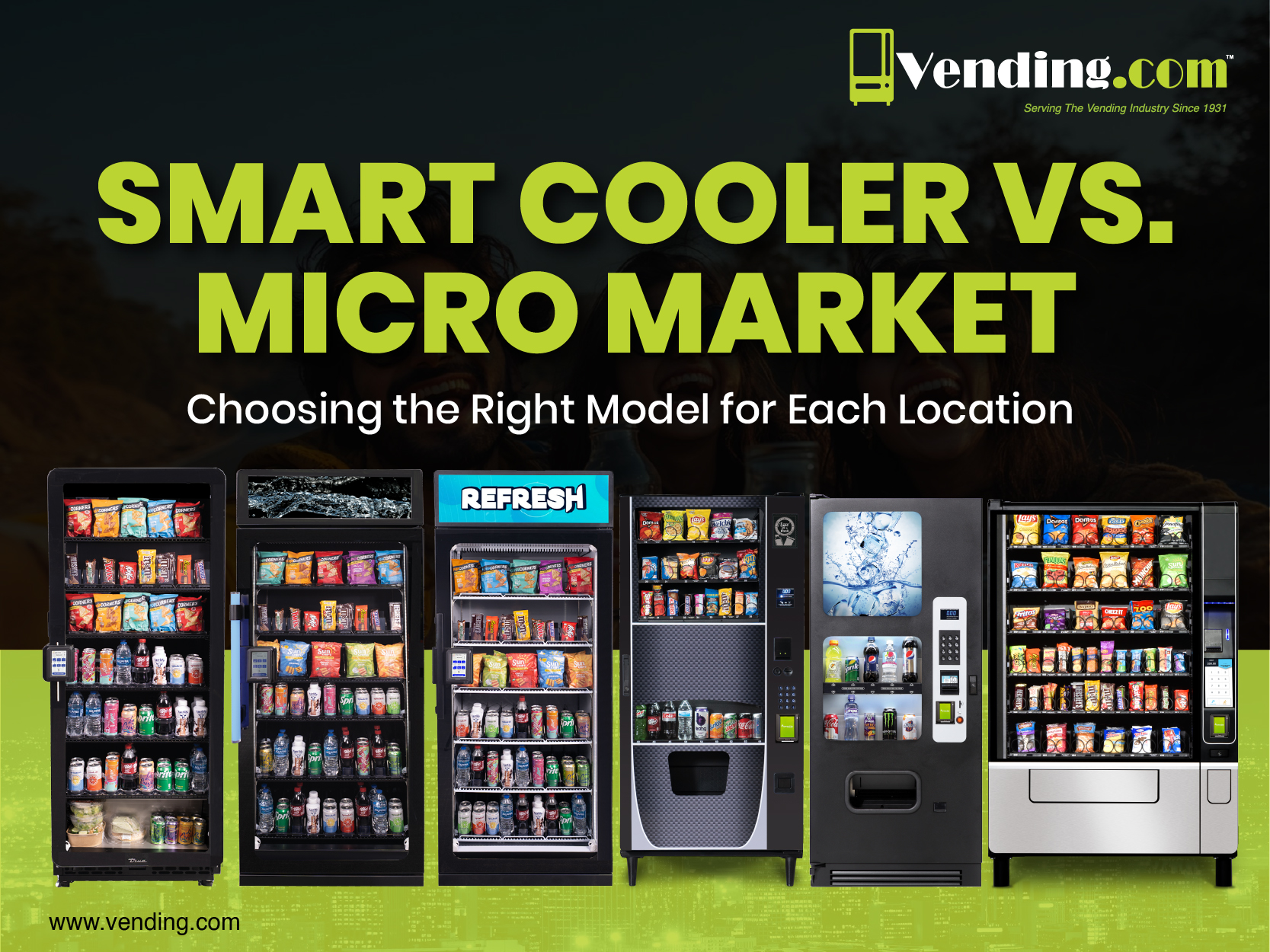
Smart Cooler vs. Micro Market: Choosing the Right Model for Each Location
The conversation around unattended retail has evolved. Facility directors, procurement teams, and operations leaders are no longer debating if self‑service food and beverage access makes sense; that decision is already settled.
The real challenge now is sharper: which format delivers the best operational and financial outcome for each location?
Choosing the wrong model doesn’t just mean a poor fit. It can lead to underperforming revenue, wasted CAPEX, higher labor costs, and frustrated customers. The right choice, on the other hand, unlocks scalable growth, stronger ROI, and a smoother customer experience.
That’s why comparing smart coolers and micro markets isn’t about preference; it’s about aligning each format to the realities of your site profile, traffic patterns, and operational goals.
Smart coolers and micro markets are both strong models. They serve different site profiles, different traffic patterns, and different operational environments. Choosing the right unattended retail technology is what separates high-performing deployments from expensive underperformers.
Estimate your route potential: use the vending machine profit calculator to model revenue, expenses and ROI before choosing a machine.
Space and Footprint: Matching Format to Site Reality
Micro markets shine in large, high‑traffic environments where dedicated space for shelving, refrigeration, kiosks, and customer movement is available. That investment makes sense when volume is high enough to support it.
Smart coolers, on the other hand, deliver the same grab‑and‑go convenience in a compact, self‑contained format that fits easily into breakrooms, lobbies, corridors, and gyms. This flexibility makes them viable in many locations where a full micro market would not be practical; they can also serve as part of a hybrid micro market setup, extending product access into smaller spaces around a larger market.
The table below compares criteria that directly affect deployment decisions: footprint, placement flexibility, location size, expansion model, and revenue per square foot. Each factor shows how the two formats perform differently, helping operators match the right model to the right environment.
| Smart Cooler | Micro Market |
|---|---|
| Compact and self-contained | Requires dedicated retail-style space |
| Fits easily in breakrooms, lobbies, corridors, and gyms | Best suited for larger centralized areas |
| Ideal for small to mid-size locations | Ideal for high-density, high-traffic environments |
| Enables incremental unit expansion | Requires larger upfront buildout |
| Higher revenue per sq. ft. in constrained spaces | Strong revenue in high-volume environments |
Why This Matters:
Smart coolers dramatically expand the number of locations that qualify for profitable unattended retail. More viable placements mean more total revenue opportunities. Micro markets maximize revenue in high traffic hubs, while smart coolers unlock smaller or variable traffic sites that would otherwise be excluded. Together, they broaden your portfolio strategy.
Staffing and Operations: Understanding the Labor Profile of Each Model
Both smart coolers and micro markets require operational management, but the labor profile differs in ways that directly affect margins and scalability.
- Smart coolers streamline operations with faster restocking, automated inventory tracking, and lower labor per stop. This efficiency helps operators expand into more locations without adding significant route costs.
- Micro markets, while more labor‑intensive, justify the effort in high‑volume environments. Shelf organization, expiration checks, and kiosk maintenance are offset by stronger revenue potential and broader product variety. At large sites, greater labor investment translates into higher overall sales and customer satisfaction.
| Smart Cooler | Micro Market |
|---|---|
| Faster, predictable restocking | Longer restocking due to open shelving |
| Automated product-level inventory visibility | Requires active inventory management |
| Minimal merchandising effort | Ongoing shelf management and expiration checks |
| Lower labor per stop | Higher labor per stop, offset by stronger revenue potential |
| Enables more stops per route | Fewer stops, but higher revenue per location |
Why This Matters:
Labor efficiency drives ROI differently across formats. Smart coolers reduce servicing costs and make expansion easier, while micro markets leverage higher traffic and product variety to offset labor demands. The right choice depends on whether your priority is scaling efficiently across many sites or maximizing revenue in large, centralized environments.
CAPEX and Expansion: Aligning Investment to Traffic Confidence
Micro markets require significant upfront investment in shelving, refrigeration, kiosks, security systems, and installation. In high‑performing, high‑traffic locations, that investment pays off with strong returns and broader product variety. But in uncertain or emerging sites, the risk of over‑investing is much higher.
Smart coolers lower that risk by reducing setup costs, simplifying installation, and enabling modular expansion. Operators can start small, validate demand, and then scale incrementally, making them ideal for variable or space‑constrained environments.
| Smart Cooler | Micro Market |
|---|---|
| Lower initial setup cost | Higher upfront investment |
| Minimal installation complexity | Moderate to high installation complexity |
| Strong pilot program viability | Better suited to proven locations |
| Incremental expansion model | Large-format expansion model |
| Best fit for variable or emerging traffic sites | Best fit for established high-volume locations |
Why This Matters:
The big insight is that smart coolers let operators test demand with lower risk, while micro markets maximize returns in proven, high‑traffic environments. A smarter expansion strategy is to deploy smart coolers first to validate demand, then scale the highest‑performing sites into micro markets once sustained traffic justifies the investment.
Loss Prevention: Building the Right Controls for Each Environment
Shrinkage is a reality in any unattended retail solution, but the level of control differs by format.
- Micro markets rely on open access, which encourages browsing and higher sales volume. However, that same openness naturally increases the risk of shrinkage, requiring active prevention measures such as cameras, auditing, and inventory reconciliation. In high‑traffic environments with strong management infrastructure, these controls are effective and justified by the revenue potential.
- Smart coolers provide more control by limiting product access and automating inventory tracking. Pre‑authorized payments, RFID or computer vision, and controlled entry make shrinkage easier to manage at scale, especially in locations with limited oversight.
| Smart Cooler | Micro Market |
|---|---|
| Controlled product access | Open access browsing |
| Automated inventory accountability | Requires active auditing |
| Lower shrinkage exposure | Higher exposure, manageable with proper controls |
| Best fit for limited-oversight locations | Best fit for high-traffic sites with active management |
Why This Matters:
The big insight is that open access drives engagement but increases the risk of shrinkage, while smart coolers deliver tighter control and predictability. Operators should match the format to the environment: use smart coolers where oversight is limited, and deploy micro markets where management infrastructure can actively balance openness with security.
Checkout Experience: Friction Reduction Across Both Formats
Micro markets improved unattended retail by introducing kiosk‑based self‑checkout. This works well in high‑traffic environments where customers want to browse a wider range of products. The trade‑off is that kiosks can slow transactions during peak hours, with queues and multi‑step payments.
Smart coolers focus on speed. Tap‑to‑open access, app authentication, and automated cashless payments make transactions faster and more convenient, especially in time‑sensitive environments like offices, gyms, and healthcare facilities.
| Smart Cooler | Micro Market |
|---|---|
| Controlled product access | Open access browsing |
| Automated inventory accountability | Requires active auditing |
| Lower shrinkage exposure | Higher exposure, manageable with proper controls |
| Best fit for limited-oversight locations | Best fit for high-traffic sites with active management |
Why This Matters:
The core difference is simple: smart coolers prioritize speed, while micro markets prioritize browsing and variety. Operators should match the format to customer expectations, use smart coolers for quick convenience, and use micro markets in environments where customers value choice and don’t mind spending more time at checkout.
Matching the Model to the Location
The most important factor in unattended retail isn’t format preference; it’s choosing the right model for the location. Here’s how that typically breaks down:
| Environment | Recommended Model | Why It Fits |
|---|---|---|
| Large corporate campuses | Micro Market | High traffic supports broader product variety and larger deployments |
| Hospitals and healthcare facilities | Smart Cooler | Faster transactions, controlled access, and space efficiency |
| Apartment and residential communities | Smart Cooler | Enables 24/7 access without staffing requirements |
| Manufacturing and warehouse breakrooms | Smart Cooler | Works well with shift-based traffic and limited floor space |
| High-traffic university environments | Micro Market | Volume supports open-access retail economics |
| Hotels and hospitality properties | Smart Cooler | Compact footprint allows flexible placement |
| Hybrid and flex office environments | Smart Cooler | Lower deployment risk in variable-attendance workplaces |
| Established high-volume workplace cafés | Micro Market | Sustained traffic justifies full market investment |
The Smart Location Strategy
Smart coolers and micro market solutions aren’t competing solutions, but they’re not equal-weight options either.
For most locations, smart coolers are the stronger starting point. They deploy faster, cost less to set up, deliver stronger smart-cooler business ROI across a wider range of site profiles, and scale without adding operational complexity.
Micro markets deliver their best results under specific conditions: large, sustained traffic volumes and dedicated management infrastructure. Micromarket solutions perform best in large, high-traffic locations with dedicated management infrastructure and sufficient volume to justify open-access retail.
Unlock Growth with the Right Retail Strategy
Looking to evaluate which model best fits your locations? Contact Vending.com to evaluate your locations, compare smart cooler and micro market ROI, and design a deployment plan that reduces risk while unlocking new revenue opportunities. Start today and turn every site into a profitable, customer‑friendly destination.
FAQs
1.Which is more profitable: a smart cooler or a micro market?
Profitability depends on the location profile.
Micro markets can generate higher total revenue in large, high-traffic environments because they support broader product variety and longer browsing behavior. Smart coolers, however, often deliver stronger smart cooler business ROI in smaller locations due to lower labor requirements, lower shrinkage exposure, and lower upfront investment.
The most profitable strategy is to match the format to the site’s traffic and operational realities.
2.Are smart coolers replacing micro markets?
No. Smart coolers and micro-market solutions are increasingly used together as part of a broader unattended retail strategy.
Smart coolers are ideal for smaller or variable-traffic locations where speed, space efficiency, and lower deployment risk matter most. Micro markets remain highly effective in larger environments where sustained traffic can support open-access unattended retail technology and expanded product selection.
3.How do businesses decide between a smart cooler and a micro market?
The decision typically comes down to five operational factors:
- Traffic volume
- Available space
- Labor capacity
- Security oversight
- Investment confidence
Smart coolers are often the better fit for emerging or space-constrained locations. At the same time, micro-market solutions make more sense in established, high-volume environments where the larger investment can be fully utilized.